
How to Reverse-Engineer Any High-Converting Landing Page (and Build One That Beats It)
A 3-step AI framework to steal your competitor's strategy without stealing their words.

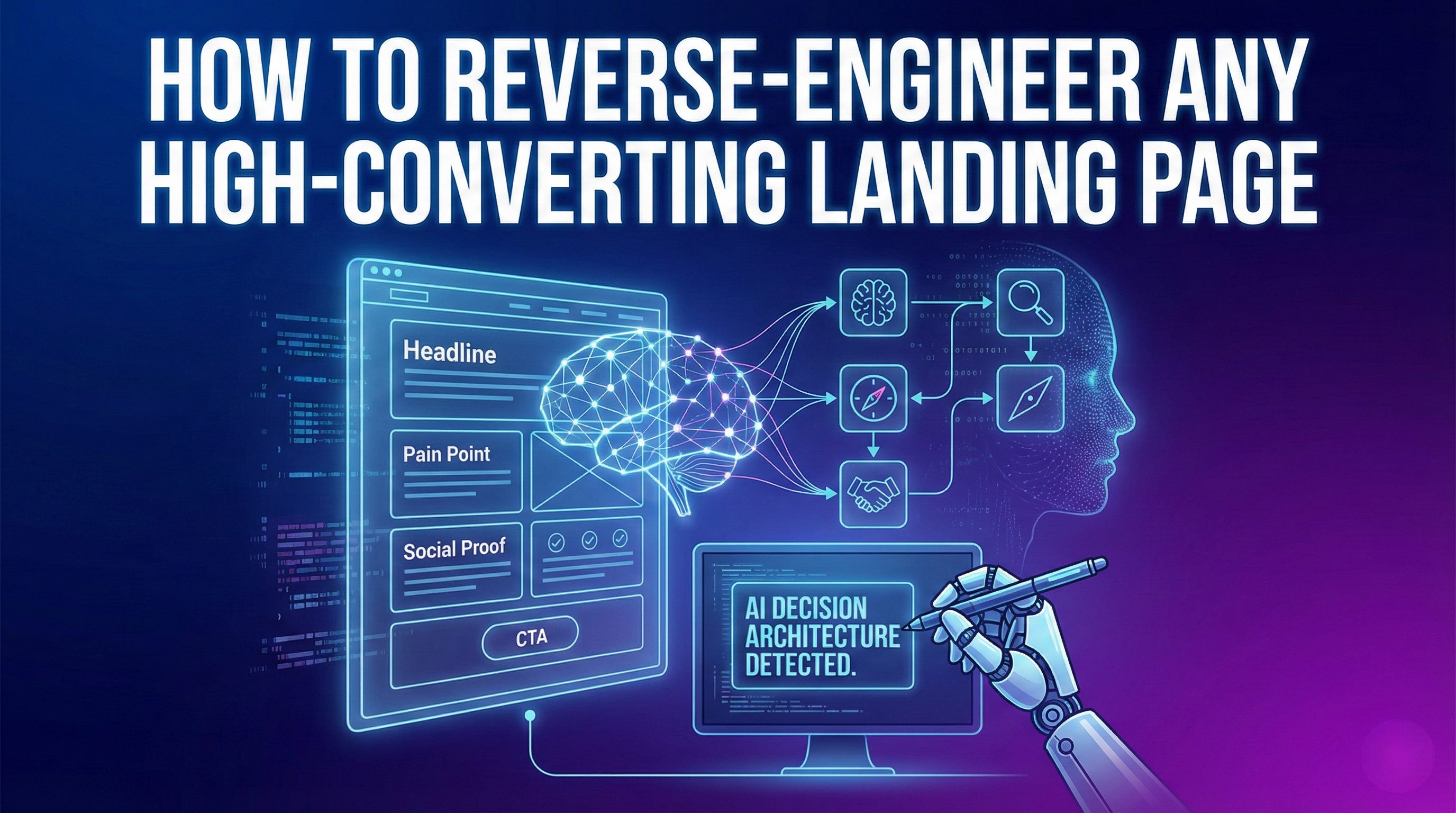
Most people think great landing pages come from creativity.
They don’t.
They come from decision architecture.
A landing page that converts isn’t “clever copy.”
It’s a carefully sequenced set of psychological decisions that moves a reader from:
“This isn’t for me”
to
“I should probably do this now.”
Here’s the good news:
AI is extremely good at reverse-engineering those decisions.
Not by guessing conversion rates or traffic sources—but by analyzing structure, logic, and persuasion flow.
In this post, I’ll show you a simple 3-step process you can use to:
Analyze a competitor’s landing page
Analyze your own product
Build a new landing page using the same logic—but stronger execution
No hype.
No copying.
No legal grey areas.
Just a repeatable system you can use for any product.
The Core Idea (Simple Version)
The process looks like this:
Analyze a competitor landing page to extract why it works
Analyze your product to identify where you are stronger or different
Build a new landing page using the competitor’s decision logic + your advantages
That’s it.
The key is how you prompt the AI at each step.
Step 1: Analyze the Competitor Landing Page
(Extract logic, not copy)
Your goal here is not to rewrite their page.
Your goal is to extract the decision blueprint behind it.
Paste the full landing page copy (or as much as you can) into AI and use this prompt:
Prompt 1: Competitor Landing Page Analysis
You are a conversion strategist and behavioral psychology expert.

Analyze the following landing page.

Do NOT rewrite the copy.
Do NOT suggest improvements yet.

Your task is to reverse-engineer the decision logic behind the page.

Extract and explain:

1. The core promise being made to the visitor
2. The primary pain or fear being activated
3. The target audience identity this page is speaking to
4. The persuasion sequence (what the reader is meant to believe first, second, third, etc.)
5. The key objections the page anticipates and how it addresses them
6. The type of proof used (social proof, authority, logic, transformation)
7. How urgency or motivation is created
8. The role of the CTA (soft, hard, identity-based, urgency-based)

Return the output as a structured breakdown.
Focus on psychology and structure, not wording.

Landing page content:
[PASTE LANDING PAGE HERE]
What You Should Get Back
A good output will feel like a strategy document, not marketing copy.
You’re looking for insights like:
“This page delays the product reveal until trust is established”
“It neutralizes price anxiety before the CTA appears”
“It speaks to identity before it speaks to features”
Save this output.
You’ll use it in step 3.
Step 2: Analyze Your Own Product
(Surface your unfair advantages)
Now we flip the lens.
This step prevents your new page from becoming generic.
Use this prompt:
Prompt 2: Product & Positioning Analysis
You are a positioning strategist.

Analyze the following product honestly and realistically.

Your goal is to identify:
- Who this product is best for
- Who it is NOT for
- The strongest outcome it delivers
- The main reasons someone would hesitate to buy
- The product’s unfair advantages compared to competitors
- Where it is clearer, simpler, faster, safer, or more specific
- Any constraints or limitations that should be acknowledged

Do NOT exaggerate benefits.
Do NOT invent proof.

Return a positioning and differentiation summary that can be used to build a high-trust landing page.

Product details:
[DESCRIBE YOUR PRODUCT HERE]
Why This Step Matters
Most landing pages fail because they try to sound impressive.
Strong pages sound clear.
This step ensures:
Your claims are believable
Your positioning is focused
Your page speaks to the right buyer, not everyone
Again, save this output.
Step 3: Build a New Landing Page
(Reuse logic, improve execution)
Now we combine both analyses.
The rule here is important:
You reuse the competitor’s decision logic — not their copy, layout, or phrasing.
Use this final prompt:
Prompt 3: Landing Page Creation
You are a senior conversion copywriter.

Using the competitor decision analysis and the product positioning analysis below, create a new landing page.

Rules:
- Follow the persuasion sequence from the competitor analysis
- Use ONLY the truths and advantages from the product analysis
- Do not copy phrasing, headlines, or structure directly
- Prioritize clarity over hype
- Address objections before asking for commitment
- Use simple, direct language

The goal is to outperform the competitor by being:
- More specific
- More honest
- More focused on outcomes

Structure the page with:
- Clear section headings
- Short, readable paragraphs
- A logical progression toward the CTA

Competitor decision analysis:
[PASTE OUTPUT FROM STEP 1]

Product positioning analysis:
[PASTE OUTPUT FROM STEP 2]
What This Process Does (and Doesn’t Do)
✅ What It Does
Eliminates guesswork
Prevents “me too” copy
Forces clarity and positioning
Produces repeatable results
Works across niches and products
❌ What It Doesn’t Do
It doesn’t magically guarantee conversions
It doesn’t copy competitors
It doesn’t replace testing and iteration
Think of it as engineering a better starting point.
The Mental Model to Remember
The competitor page shows you the map
Your product determines the vehicle
Your new landing page is a faster route
You’re not copying success.
You’re understanding it.
Why I’m Sharing This
Most people struggle with landing pages because they think the problem is writing.
It’s not.
The problem is decision design.
AI makes this visible—if you ask the right questions.
If posts like this are useful to you, subscribing means you’ll get:
More practical systems
More repeatable frameworks
Fewer opinions, more processes
No hype.
Just things you can actually use.
Pro Tip: This works for more than just landing pages. You can use the exact same 3-step process to reverse-engineer high-performing LinkedIn posts, Twitter threads, or cold emails.